One Way to Get Better at Pacing Workouts and Races
Matt Fitzgerald
Apr 16, 2026
COPY LINK
A number of years ago, I was doing a marathon-pace run on my home treadmill when I realized the calibration was off. I’d set the belt to 9.5 mph, having estimated my current marathon pace at 6:19 per mile, but it felt too easy. Curious, I stopped the treadmill early and ran the last mile of the workout outside, using GPS to data to determine how fast I’d actually been running inside.
As part of this test, before I got off the machine, I made a conscious mental imprint of my overall exertion level and kinesthetic markers of my velocity, such as the amount of force my foot was applying to the surface when I pushed off, the length of my stride, and my stride rate. When I resumed running outside, I recreated these sensations in an effort to replicate the precise speed at which I’d been running indoors. Once I’d settled into a pace that felt right, I looked at my watch and saw that I was running 6:30 per mile, which is 3 percent slower than the reading my treadmill had given me.
The following week, a technician came over to service and recalibrate my treadmill. When I asked him how far off it was, he told me, “Oh, it wasn’t really off at all. Just 3 percent.”
Impressed? You shouldn’t be. Every runner should be able to do what I did in this anecdote. A runner who can’t perceive a 3 percent difference in speed is like a singer who can’t hear the difference between middle D (293.66 Hz) and a wrong note that is 3 percent sharper or flatter, except the consequences are different. Whereas the singer gets booed off stage, the runner reaches the finish line 3 percent slower than they would have done with better pacing.
But does this analogy really hold? After all, in most circumstances, a runner can just use their watch to hold a certain pace, yet there’s no equivalent in singing (and don’t say Autotune, which doesn’t change the pitch of the note that is actually coming out of the singer’s mouth but merely corrects it once it’s out). In fact, though, reliance on external technologies cannot correct the pacing of a runner who sucks at it. A classic Coach Matt thought experiment will show you why.
The Pacing Olympics
Suppose 100 runners are asked to hold a pace that is equivalent to their individual lactate threshold for 10 minutes while wearing watches set to display their current pace in real time. Meanwhile, observers record how often the runners glance at their watches during these 10 minutes. This experiment has never been tried, but there have been enough studies of similar design to know what the results would be: The runners who check their watches most frequently will spend the least cumulative time at their target pace, while the winner of the Olympics will be demonstrate minimal reliance on their device.
Why? Because the best pacers are like me, able to imprint the feel of a certain pace and hold that pace by feel with only occasional checks of objective data to stay on track. Poor pacers have no idea what their target pace (or any other pace, for that matter) feels like. Unlike pacing masters, who are able to perceived the slightest variations in pace, they have only two buckets: fast and slow. If you ask them to jog, they’ll jog, but if you ask them to accelerate from a jog to any target pace faster than a jog, they’ll shoot out of a cannon, regardless of whether the target is marathon pace or 5K pace.
Or lactate threshold pace. Hence, they’ll start the 10-minute pacing challenge way too fast. And because they have no faith in their ability to find the right pace by feel, they’ll check their watch right away, see that they’ve overshot the mark, and slow down. But because they only know two speeds—fast and slow—they’ll overcompensate, slowing down too much. And because they’re making no effort to pay attention to perceptual indicators of pace, they’ll soon check their watch again, see they’ve overcompensated, and promptly overcompensate in the other direction. And so on.
The graph below shows a real athlete’s pace from an interval session in which the athlete did exactly what I’ve just described.
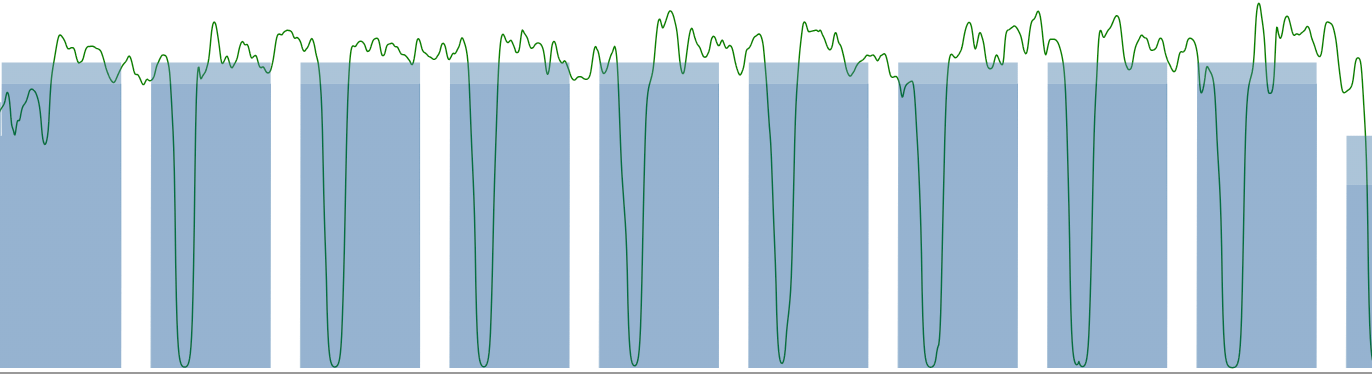
As you can see, they spent virtually zero time actually running at the speed they ended up averaging in each interval, which is colossally wasteful. An athlete who did this in a race would finish more than 3 percent slower than they should. Every bend in the line is marked by a check of the watch. That’s a lot of watch checks, and they clearly did not help the runner pace their intervals efficiently. In fact, they did the opposite.
Now let’s consider the runner in this thought experiment who succeeds in spending the most time at their individual lactate threshold pace. At the start, knowing that their threshold pace is sustainable for about 55 minutes, they will pretend they’re running a 55-time trial and feel their way to a pace they could sustain for this long and no longer. In other words, they will actually put some thought into their initial pace selection. As a result, when they execute their first check of the watch 20 or 30 seconds in, they’re likely to see that they are either right on pace or just slightly off.
Let’s say the runner discovers that they’re running 5 second per mile too fast. In this case, they will ease back a teensy bit, making sure not to overcompensate, as 5 seconds per mile works out to just 1 second every 322 meters. (When I make this type of micro-adjustment, I picture myself gradually losing contact with a doppelganger who doesn’t slow down.) At the same time, they will mentally imprint the feeling of running at this pace, just as I did before hopping off the treadmill in my marathon-pace workout. Having captured this feeling, they will lock into it and carry it forward, making sure they continue to push off the ground with exactly the same amount of force and maintain exactly the same stride length, stride rate, and overall effort. Only when they sense that their pace may have drifted slightly in either direction, or when they sense they’re “due” for a check-in, will they glance again at their watch. And so on.
In short, the reason most runners suck at pacing and aren’t getting better at it is that they’re making absolutely no effort to get better at it. By depending on their watches and not paying attention to their perceptions, they not only ensure poor pacing today but also guarantee that they’re still pacing poorly next year. To break this vicious circle and begin to develop their pacing skill, these runners must emulate the habits of pacing masters like me: putting some thought into their initial pace selection instead of defaulting to a crude fast/slow binary; checking their watch infrequently; making small adjustments and guarding against overcompensation; mentally imprinting the feeling of running at the right pace; and locking into the right pace through deep and sustained attention to relevant sensory queues.
Autotune for Runners
“Yeah, but what if I have a pair of Meta Glasses, so I can see my pace continuously?” calls a voice from the gallery. “Won’t I pace just as well as you?”
Absolutely not. In fact, those fancy glasses will only exacerbate your lack of pacing skill. True, continuous visual access to pace data will help you run more steadily, but it will also cause you to pay even less attention to your internal perceptions, so you’ll have no idea how to interpret your perceptions and no clue what the right pace even is at any given moment in any given race. Human endurance performance is limited by perceptions, not by physiology, and still less by measurements, so the only way an athlete can reach the finish line of a race in the least time possible is to feel their way to the absolute limit of their potential on that particular day.
Calculating the right pace ahead of time and then gluing yourself to it with the help of your glasses throughout the race won’t result in your best possible performance because it’s very unlikely your calculation will perfectly align with your true performance limit on that day, which is fundamentally unknowable because it depends on a myriad of factors that are everchanging. And what happens if you feel better than expected, or worse, or you go through a rough patch or catch a second wind? What happens when you encounter a hill or loose footing or a headwind? What happens if the temperature gradually warms or you end up in a battle with another runner in your age group?
In all of these circumstances and many others, technology won’t help you. You must be self-reliant, which only works if you’re the kind of runner who is able to calibrate their own treadmill by feel, and the only way to become that runner is to practice pacing your workouts—all of them—like the winner of my imaginary Pacing Olympics. Good luck to you!
Thanks for reading 🤍
Matt Fitzgerald & the MarathonGuide team
COPY LINK
You are free to use this material for non-commercial purposes. This means you can read it, share it with others, and use it in your own personal projects. For more information on the rules for using this material, please read the following documents:
Creative Commons LicenseAll rights reserved. Copyright © 2026 Marathon Guide